
Organic gem
Pearls
Akoya, freshwater and Tahitian: grown by living molluscs
- From
- Cultured in Asia · the South Pacific
- Wear
- 2.5 · soft; last on, first off
- Gift
- June birthdays · 30th anniversary (traditional)
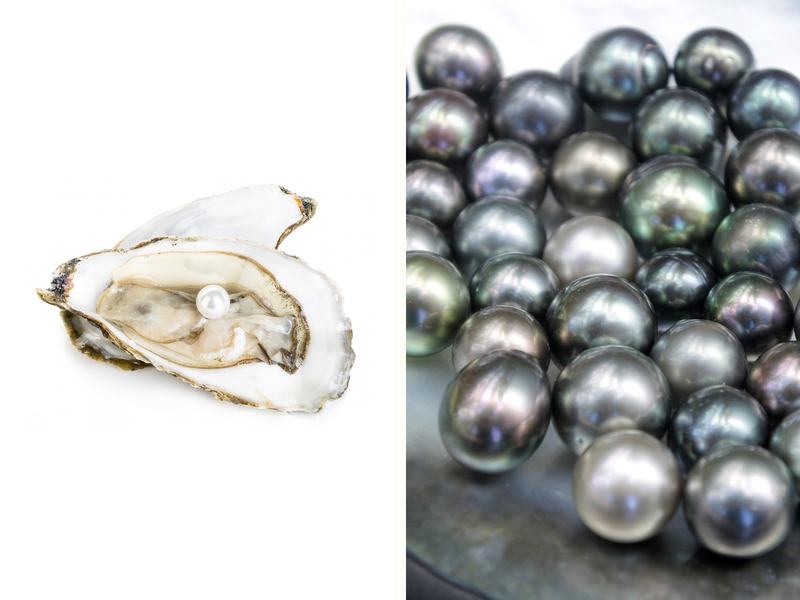
Every other gem in this guide was formed in rock. A pearl grows inside a living mollusc, layer upon layer of nacre, the same lustrous material that lines the shell. Natural pearls form by chance and are rare; almost all pearls sold today are cultured.
Pearls are not African. Today's cultured pearls are grown mainly in Asia and in the islands of the South Pacific.
How a cultured pearl grows
A pearl farmer places a small piece of mantle tissue, often with a round bead, inside the mollusc. The mollusc forms a pearl sac around it and coats it in nacre. Whole cultured pearls were first produced around 1900 and became important by the 1920s.
The three you will see most
- Akoya: the classic round white or cream pearl, usually 6 to 8 millimetres.
- Freshwater: grown in lakes and ponds, many to a mollusc; the widest range of shapes and colours, and the most produced.
- Tahitian: from the black-lipped oyster, in dark greys, greens and the shimmering "peacock".
Beliefs and legends
Pearls have been linked with the moon since ancient times. In China they were said to protect against fire and fire-breathing dragons, and in Europe they stood for purity. The best-known pearl story is Cleopatra's wager with Mark Antony: to win it, she is said to have dissolved a pearl in vinegar and drunk it. Historians doubt it happened, though the chemistry is possible.
Treatments, honestly
Some pearls are dyed or irradiated to change their colour. Dye often shows as colour gathered around the drill hole. Any treatment we know of, we tell you.
How to judge a pearl
Pearl experts look at seven things: size, shape, colour, lustre, surface, nacre quality, and how well the pearls of a strand match. For most people, lustre matters most: a fine pearl reflects your face sharply, a dull one only glows.
Caring for your pearls
Pearls are soft, about 2.5 on the Mohs scale, and heat and strong light can crack the nacre. Put them on last, after perfume, hairspray and make-up, and take them off first. Wipe them with a soft cloth after wearing. Never use an ultrasonic or steam cleaner, and let a strand dry flat before you put it away.
At a glance
| What it is | Nacre, grown by a mollusc; almost all cultured |
|---|---|
| Hardness | about 2.5 Mohs; very soft |
| Kinds | Akoya, freshwater, Tahitian |
| From | Cultured in Asia and the South Pacific |
| Treatments | Some dyed or irradiated; disclosed |
| Care | Last on, first off. Soft cloth. No ultrasonic, no steam |
See it in Knysna
See it in Knysna: both of our shops carry diamonds and tanzanite, and our workshop can set the stone you choose.