
African gemstone
Garnet
A family of colours, and the diamond diggers' clue
- From
- South Africa · Tanzania · Kenya
- Wear
- 6.5 – 7.5 · pendants and earrings; rings with care
- Gift
- January birthdays · 2nd anniversary (GIA list)
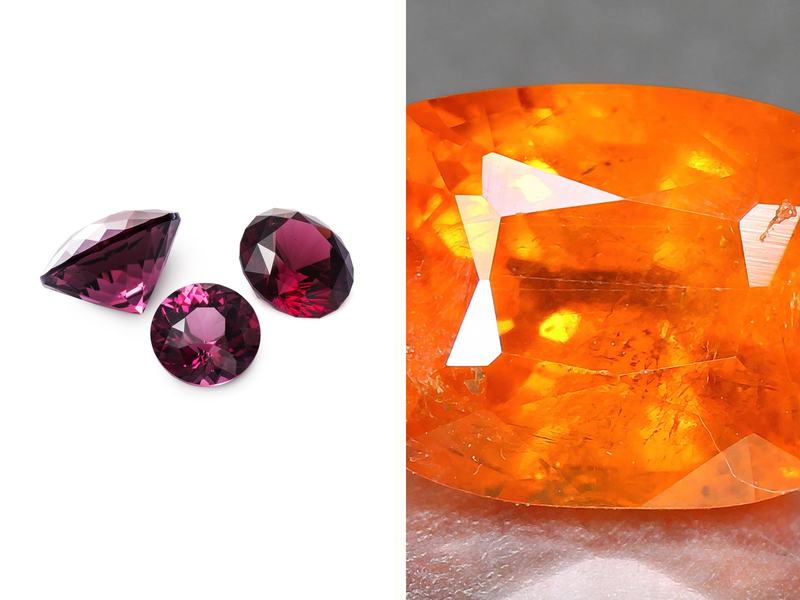
Most people picture garnet as a deep wine red. That is only the beginning. Garnet is a family of minerals that share one crystal structure and swap elements in and out as they grow, so the family runs from red and purple through orange and gold to vivid green. The name comes from the medieval Latin granatus, "pomegranate", for the red seeds the gem resembles.
The diamond diggers' clue
Garnet has a South African story of its own. When diamonds were first found along the Orange and Vaal rivers in the late 1860s, the diggers soon noticed that garnets were often a very good sign that diamonds were nearby. Deep red garnets from South Africa were once sold as "Cape rubies", a name that sounds grand but is wrong: they are garnet, not ruby.
Beliefs and legends
The pharaohs of Egypt were buried with necklaces of red garnet, to wear in the next life. Under its old name, carbuncle, garnet was said to be one of the four precious stones God gave King Solomon, and in the Middle Ages red garnet was the stone of churchmen and nobles.
The colours, and their names
- Red to purplish red (almandine, pyrope and the rose-purple rhodolite): the classic garnets.
- Orange (spessartine): the purest, brightest oranges are sold as mandarin garnet.
- Green (tsavorite and demantoid): tsavorite is green grossular from Kenya and Tanzania, and has its own stand in our shop; demantoid is green andradite, known for its fire.
- Orangey brown to cinnamon (hessonite).
- Colour change and stars: a few garnets change colour between daylight and lamplight, and some show a star.
Treatments, honestly
Most garnets are sold exactly as they come from the ground. Fracture filling is used only rarely. Any treatment we know of, we tell you.
How to judge a garnet
- Variety first. Green tsavorite and demantoid are rare and priced far above the common reds.
- Colour. In every variety, look for a lively, saturated colour.
- Clarity depends on the variety. Red garnets are usually clean to the eye; spessartine and hessonite often carry inclusions.
- Size. A large red garnet costs little more per carat than a small one, but the rare greens climb steeply with size.
Caring for your garnet
Garnet is 6.5 to 7.5 on the Mohs scale: fine for pendants and earrings, and for rings worn with some care. Clean it in warm soapy water with a soft brush. Avoid steam, and avoid ultrasonic cleaning if a stone has fractures. Store it apart from harder gems such as diamond and sapphire.
At a glance
| Mineral | Garnet group (a family of related minerals) |
|---|---|
| Hardness | 6.5 – 7.5 Mohs |
| Colours | Red, purple, orange, gold, green; colour change and star stones |
| From | South Africa (red garnets on the diamond fields, once sold as "Cape rubies"); tsavorite from Tanzania and Kenya |
| Treatments | Most untreated; fracture filling rare |
| Care | Warm soapy water, soft brush. No steam |
See it in Knysna
See it in Knysna: both of our shops carry diamonds and tanzanite, and our workshop can set the stone you choose.